Welcome
to the 2012 edition of the model railroad web site
of

December 2011:
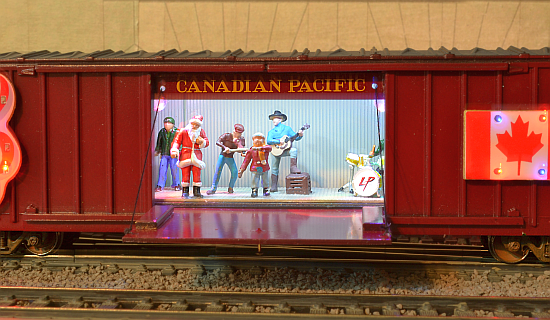
The annual Christmas Holiday Train comes to RHJ Rail. This year saw the
addition of a new
stage car with flashing external lighting, a folding side door, a group
of performers and, of course, Santa Claus.
Interior lighting has both flood lights and variable coloured spot lights.
Lighting effects are controlled by DCC.
Appropriate seasonal music is played automatically.
To view some more photos of RHJ Rail, visit the Bow Valley Model Railroad Club web site - Photos/Home Layouts/Richard Johnson
|
The major new feature this year was the brand new stage car above. It was constructed based on an Athearn 50-foot double door boxcar with operable doors centered on each side of the car. The doors on one side were removed, a header strip was added at the top of the opening and a folding side door was installed. This door is weighted to hold it in both the open and closed positions and is counterbalanced by weights inside the car. The car was painted in Canadian Pacific passenger car colours. Scribed styrene was put on the interior walls and floor and painted a light colour. Figures, including musicians and Santa Claus, were added. The electronics consist of a Digitrax DH123 decoder powering LED flood, coloured spot, and external flashing lights. The decoder is powered from the electrical pick-up in the locomotive via an electrical line running through the cars between the locomotive and the stage car, enabling lighting effects to be controlled by DCC. Not coincidentally, this design fits nicely with the recently added Automated Operations Control Centre (AOCC), allowing the entire train and stage car lighting to be controlled by DCC and computer. In operation, the train automatically traverses the layout, stopping at various locations, and the AOCC plays appropriate seasonal music at different locations depending where the train is at any given time. Other trains may be run manually or automatically at the same time. Other significant
advances on the layout over the past year are recorded here. Other versions of this web site: |