"Old Layout" (1970 - 2002)
Background
Model railroading has been my hobby for many years, starting with Hornby Dublo, a British "00" gauge three-rail system as my first electric train in the mid 1950s. Even before that, I had a variety of O-gauge clockwork tinplate equipment. I "collected" several additional makes of model railroad equipment including "Trix Twin", Revel, and others but ultimately settled for normal HO scale items.
As HO scale became more popular, it was adopted as the RHJ Rail standard and, as time passed, it provided a wide variety of North American prototype equipment from which to choose. Particular interests were western Canadian prototype equipment, particularly Canadian Pacific Railway (early diesel), some CP Rail, Rockymountaineer Railtours and Heritage Park in Calgary. Over the last few years, quality (and price) has improved significantly so that there is an even larger variety of items available with near perfect scale reproduction and very reliable operation.
RHJ Rail includes the model railroading division while RHJ Shows includes the circus and amusement park division of this vast conglomerate HO enterprise. They are often displayed together on the club layout at model railroad shows and other events.
Home Layout
The earlier home layout was constructed in the early 1970s as the Rodgers and High Creek Junction Railway (RHJ Rail). It was built in HO scale in a 12 x 12 foot room in the basement. Its configuration could be described as a folded dog-bone duck-under with fairly steep ruling grades.
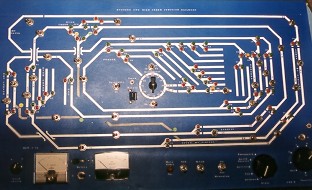
The layout had conventional DC block control with 32 blocks, 45 remote control turnouts, two control panels and complete block detection with train location (and direction) indication on the main panel. It was possible to run up to four (theoretically, five) independent trains at one time.
The layout was briefly adapted so that DCC operation could be used as an alternative means of control.
The application to abandon the layout was submitted in 2000 and the old layout was completely removed in early 2002 to make room for the South Division of the new layout.
A few images of the layout are included below.
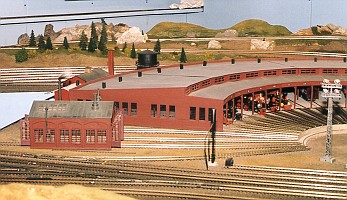
The thirteen-stall roundhouse was completely scratch-built as was the turntable. There were 25 tracks off of the turntable, with one main approach lead and two other leads as well as the roundhouse stalls and additional outside storage tracks.
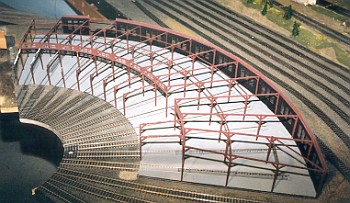
This internal view of the roundhouse during demolition shows some of the construction techniques.
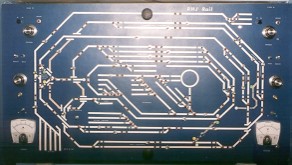
This control panel had complete block detection for all blocks and sub-blocks and showed the location and direction of every train on the layout.
This was the original control panel and controlled the turntable and all the tracks leading off from it as well all mainline blocks and sidings.
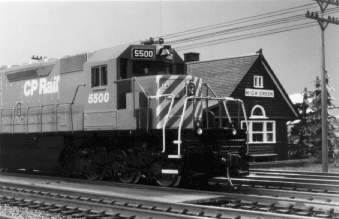
This early view of High Creek shows one of the first mainline trains through that location. SD-40 locomotives were not available from commercial sources painted in the new CP Rail paint scheme so this model of CP Rail's first such unit was hand painted.
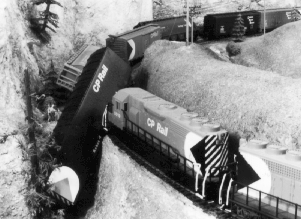
CP Rail pioneered the use of mid-train "slaves" or robot-controlled locomotives so RHJ Rail was eager to adopt this new technology. In those early days, experimentation with robot control was not always a success.
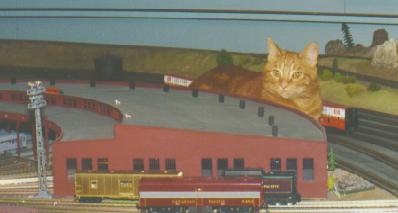
Normally, cats were forbidden on the layout but a serious security breach resulted in this situation. Increased security measures were implemented.
(The cat survived this layout but not the next one.)